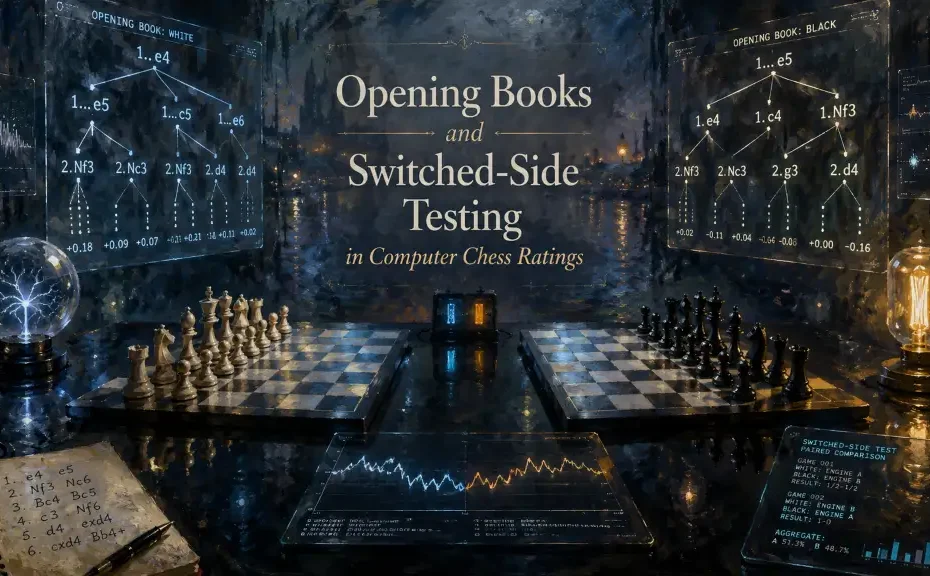
Switched-side testing reduces opening bias by making both engines face the same initial position with reversed colours. In practical terms, the method tries to stop one engine from receiving the permanent benefit or burden of a particular opening assignment. When an opening is tested twice, once with Engine A as White and Engine B as Black, and once again with colours reversed from the same starting position, the rating evidence becomes more balanced than a stream of unrelated one-off games. That is why switched-side testing is one of the clearest methodological safeguards in serious computer-chess testing. CCRL explicitly discloses “random openings with switched sides” in its 40/2 FRC list, while TCEC has documented divisions in which each engine played both White and Black from prescribed openings. Those are not cosmetic details; they are part of what the published rating evidence actually means.
For readers following chess engines ratings lists, this matters because a rating table is not defined only by Elo numbers. It is also defined by the opening method, the book source, the pairing discipline and the extent to which the test tries to neutralise structural opening bias. An engine that scores strongly in an unpaired stream of random games is not being measured in the same way as an engine tested under mirrored, switched-side conditions. The two datasets may both be useful, but they answer different questions.
Why opening book disclosure is a reliability condition
A public rating list becomes more reliable when it tells readers where the starting positions came from. That is what opening-book disclosure does. It tells the audience whether the games began from the standard initial chess position, from a curated opening suite, from a randomised book, from a UHO-style set, or from some other opening source. Without that information, readers can see the result but not the structure behind the result.
Community-recognised testing sites already treat this as normal disclosure. CCRL’s 40/2 FRC list does not merely publish ratings; it also states the testing conditions, including that games use random openings with switched sides, and that the list is computed with Bayeselo from a large game database. Ipman Chess similarly discloses specific book and testing conditions, for example “Book: UHO2024-085/094” on one rating surface, together with total games and Ordo or Elostat output. On its main page, Ipman also discloses its time controls and use of Syzygy tablebases. These examples show a broad community norm: serious public rating work should identify the opening source and the surrounding test conditions, not hide them behind the Elo table alone.
For IJCCRL, the consequence is straightforward. If an event or rating list uses a defined opening suite, that suite should be declared. If a list uses mirrored units from an internal book, the publication should say so. If a tournament or rating cut uses a filtered opening family or a defined subset such as a UHO-style suite, that should also be visible. Opening disclosure is not a minor footnote. It is part of the meaning of the rating surface itself.
What switched-side testing actually does
Switched-side testing means that the same opening setup is played twice with colours reversed. The goal is not to eliminate all bias. That is impossible. The goal is to make the bias more symmetric.
TCEC offers a good public example of the principle. In the TCEC 14 documentation, the organisers wrote that in Division 4 each engine played both White and Black from four-ply openings, and in Division 3 the engines again played both sides of prescribed four-ply openings. That language is important because it describes a deliberate mirrored structure rather than a random pile of independent games. The opening is assigned to both engines, not only to one of them.
CCRL’s phrase “random openings with switched sides” expresses the same logic in a shorter form. The openings may be randomised, but the colour assignment is still mirrored. That combination matters because a random opening policy alone does not solve asymmetry. If the opening is random but only one engine receives White from that position, the asymmetry remains. Switched sides is the extra discipline that makes the test more balanced.
In editorial terms, the simplest explanation for readers is this: if one opening line slightly favours White, both engines must be made to face that same White-favouring line, once from each side, before the test can claim reasonable opening fairness. That is the core logic.
Why “pair ratio 0” is a useful audit phrase
IJCCRL can use pair ratio 0 as a plain-language audit phrase for readers, provided it defines it clearly. In IJCCRL usage, pair ratio 0 should mean that mirrored opening work is fully closed: every opening assignment that enters the measured set has been completed with colours reversed, so no engine is left holding the one-sided benefit of a partially paired opening block. This is an IJCCRL methodological label rather than a phrase quoted from CCRL or TCEC, but it follows directly from the switched-side logic documented by those testing traditions.
Why is this useful? Because readers often do not want a long technical explanation every time they look at a tournament or a provisional rating cut. They need a short phrase that says whether opening symmetry is complete. “Pair ratio 0” can fill that role if IJCCRL uses it consistently and explains it in Rules & Audit.
A clean definition would be:
- Pair ratio 0 = no unmatched mirrored opening assignments remain in the measured set.
- Non-zero pair ratio = some opening assignments are still incomplete, so the current cut should be interpreted as provisional or partially asymmetric.
That gives readers an audit phrase they can understand without pretending that opening fairness is a mystical concept.
Why this is different from random unpaired games
A stream of random unpaired games is not the same as switched-side testing. Even if the opening source is broad and the sample is large, the individual colour/opening assignments may still be unbalanced over shorter ranges, and they may distort provisional interpretations.
Suppose one engine happens to receive a cluster of favourable White-side openings early in an event, while another engine receives more awkward Black-side assignments from similar structures. In a purely unpaired stream, those effects may eventually wash out over a very large sample, but they remain harder to audit at the level of a specific event segment or provisional cut. Switched-side testing is stronger because it closes the symmetry locally, opening by opening, not only statistically at some distant aggregate horizon.
That is why TCEC’s documented approach of making engines play both sides of prescribed openings is methodologically different from simply saying “we played many games.” It is also why CCRL’s explicit switched-side disclosure matters. The methodological claim is not only about quantity. It is about structure.
For IJCCRL, this distinction is especially important when publishing provisional reports, event-stage summaries or partial rating surfaces. If the mirrored units are not closed, the publication should say so. If they are closed, that closure becomes part of the quality statement.
How IJCCRL should report openingIndex and mirrored-unit closure
IJCCRL can strengthen its public methodology by reporting openingIndex and mirrored-unit closure explicitly in event and audit notes.
A useful system would be:
- openingIndex N: the last opening unit fully entered into the measured cut.
- mirrored units closed: the number of opening assignments for which both colour-switched games are complete.
- pair ratio 0: confirmation that the measured subset contains no unmatched mirrored units.
- scheduler closed: the event or stage has no pending games affecting the measured cut.
This is not a replacement for the game archive. It is a compact reader-facing summary of whether the opening methodology is fully closed at the moment of publication.
For example, a tournament note could say:
“Provisional rating cut taken at openingIndex 155, with 155 mirrored units closed, pair ratio 0, scheduler still active beyond the cut.”
That sentence tells the reader far more than “results after 310 games.” It says that the cut is provisional in time, but structurally balanced in opening symmetry.
This fits naturally with IJCCRL’s publication architecture. The methodological explanation can live in Rules & Audit, the competitive context in Events, and the evidence layer in Downloads and the ratings hub. TCEC’s archive interface itself illustrates the value of keeping crosstable, schedule, event and PGN surfaces visible together, because the reader can move from table to evidence rather than treating the rating output as an isolated claim.
Opening-book disclosure and public interpretation
A fair public interpretation of engine ratings requires at least four opening-related disclosures.
First, readers need to know the book source or opening source. Ipman’s UHO page is a good example of concise disclosure because it says “Book: UHO2024-085/094” directly at the top of the page. Even if a reader does not know every detail of that book, the source has been named and can be discussed publicly.
Second, readers need to know whether the list uses switched-side or mirrored testing. CCRL gives a model phrase here: “random openings with switched sides.” That is short, clear and directly relevant to interpretation.
Third, readers need to know whether the evidence comes from a closed mirrored subset or a still-evolving event stream. This is where IJCCRL’s pair-ratio language can help.
Fourth, readers need to know whether the event record and PGNs are available for audit. TCEC’s archive surface shows why this matters: crosstable, schedule, event and PGN are presented as visible archive objects rather than hidden internals. That is the right philosophy for public trust.
Reader checklist for opening fairness
Readers who want to judge opening fairness in a computer-chess rating surface can ask a short checklist:
- Was the opening source disclosed?
If the site names the book, suite or opening method, that is a good sign. - Were openings switched or mirrored?
If the site says “switched sides” or states that both White and Black were played from the same prescribed openings, the methodology is stronger. - Is the rating cut fully paired?
If mirrored units are incomplete, the reader should treat the cut as more provisional. - Are time control and other conditions visible?
Opening fairness does not stand alone; it sits beside hardware, time control and tablebase policy. Ipman’s public test pages are useful examples of that broader disclosure culture. - Can the evidence be checked?
Ratings are more trustworthy when event, schedule, crosstable and PGN surfaces exist and are linked publicly.
This checklist does not require the reader to become a chess-programming specialist. It only requires that the publication be honest enough to expose the structure behind the numbers.
What IJCCRL should own in this topic
IJCCRL does not need to replace CCRL, TCEC or Ipman. Those sites already have their own traditions and audiences. But IJCCRL can make one methodological contribution very clearly: it can explain pair-ratio-zero discipline in plain editorial language and connect it directly to live tournament reporting, PGN publication, archive control and rating interpretation.
That is a strong bridge topic between official tournament coverage and evergreen methodology. It helps explain why a provisional cut may be scientifically cleaner at 300 fully paired games than at 301 games where the mirrored companion is still missing. It also gives readers a practical reason to care about openingIndex, mirrored-unit closure and scheduler closure, which are otherwise easy to overlook.
In short, IJCCRL can turn a niche tournament-management detail into a readable public method statement.
Conclusion
Switched-side testing reduces opening bias by ensuring that both engines face the same initial position with reversed colours. That principle matters because ratings are not produced by numbers alone. They are produced by structured testing conditions.
Opening-book disclosure is therefore a reliability condition, not a decorative detail. Community-recognised public test environments already show this. CCRL explicitly discloses random openings with switched sides. TCEC has documented divisions in which each engine played both White and Black from prescribed openings. Ipman discloses book, time control and testing conditions on its public rating pages. Together, these examples support a simple conclusion: readers deserve to know not only who scored more points, but also how the openings were assigned and balanced.
For IJCCRL, the right public language is to define pair ratio 0 clearly, report openingIndex and mirrored-unit closure in audit notes, and connect rating interpretation to visible evidence surfaces such as Rules & Audit, Events, Downloads and the ratings hub. That would not replace established resources. It would give IJCCRL a precise and useful methodological voice within its own workflow.
Sources and references
- TCEC Archive
https://tcec-chess.com/archive/
Useful as a public archive surface linking crosstable, schedule, event and PGN. - TCEC 14 article / rules-style event documentation
https://tcec-chess.com/articles/TCEC_14_for_TCEC.pdf
Documents that engines played both White and Black from prescribed openings in TCEC divisions. - CCRL 40/2 FRC rating list
https://computerchess.org.uk/ccrl/404FRC/
Publicly states “random openings with switched sides” and other testing conditions. - Ipman Chess home
https://ipmanchess.yolasite.com/
Publicly states test conditions including time control and Syzygy usage. - Ipman Chess AMD R9-7945HX UHO2024 page
https://ipmanchess.yolasite.com/r9-7945hx-uho2024.php
Publicly states “Book: UHO2024-085/094” and provides rating output tied to that opening source.

Jorge Ruiz Centelles
Filólogo y amante de la antropología social africana