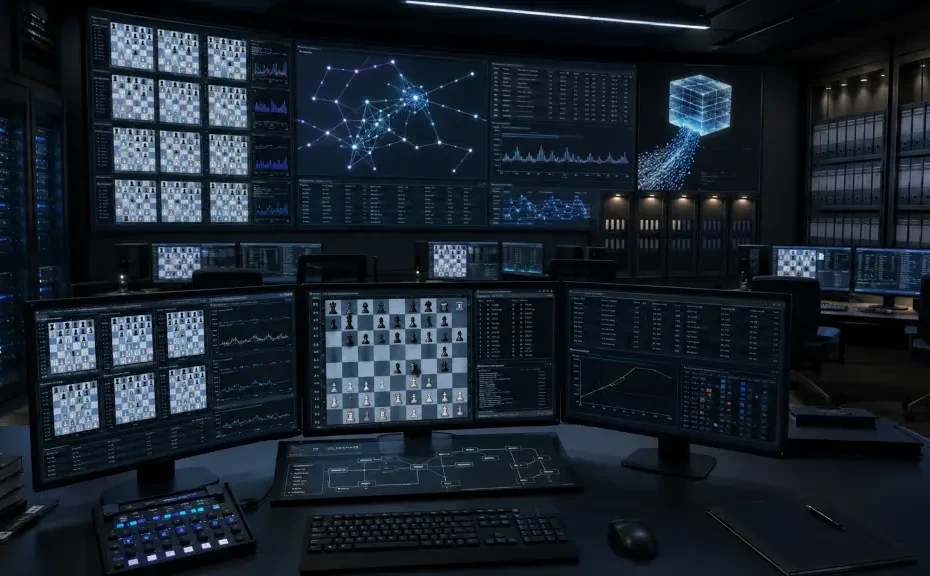
Live Tournaments and Rating Publication
Live chess engine tournaments are not only public broadcasts. In a serious computer-chess publication system, they are the first visible layer of a longer evidence chain. A game is played live, the result is recorded, the PGN becomes supporting material, the event produces standings, the standings may affect rating publication, and the closed event is eventually preserved through downloads, winners pages and archive entries.
This is why live tournaments matter for readers of chess engines ratings lists. A rating table becomes more useful when the reader can understand where the results came from, how the event was structured, what evidence supports the publication, and whether the rating surface is provisional or final. A live tournament without a publication system is only a stream. A rating list without traceable tournament evidence is only a table. The strongest model connects both.
For IJCCRL, the correct editorial structure is not to treat live broadcasts, PGN files, ratings, winners and archives as separate islands. They should operate as connected layers. The live tournament hub shows what is happening now. The ratings lists show current or historical rating surfaces. Downloads preserve PGN and event packs. Winners identify final champions. Archive pages preserve closed material after the event leaves the current cycle. Rules and audit pages explain the framework that makes publication interpretable.
This article explains how live chess engine tournaments connect to rating publication. It also defines the limits of that connection, because not every live result should automatically become a final rating claim. The goal is to build trust, not to inflate significance.
1. What a live chess engine tournament actually publishes
A live chess engine tournament publishes more than moves on a board. It publishes a sequence of observable events: pairings, colours, openings, time control, engine identities, clocks, results and final standings. If the broadcast system is well designed, these events can later be converted into structured records.
The most important record is usually the PGN file. PGN is not a rating list, but it is the evidence layer from which readers, organisers and external reviewers can inspect what was played. A rating table without access to game evidence may still be informative, but it is less transparent. A downloadable PGN pack gives the publication a stronger evidentiary base.
Live events also produce context. The reader sees whether a tournament is a league stage, knockout round, semifinal, final or tiebreak. This matters because different structures create different interpretive meanings. A round-robin league gives repeated exposure across a pool. A knockout match decides advancement under a narrower pairing structure. A final decides a winner, but it does not automatically prove that the winner has the highest long-term rating in every environment.
This distinction is central. Live tournaments produce results. Rating publication interprets those results within a method.
2. Why the publication chain matters
A responsible tournament ecosystem should answer five questions:
- What is happening live?
- What evidence will remain after the games are finished?
- Which standings are provisional?
- Which results are final?
- Where can the reader find the long-term record?
If those answers are scattered or unclear, the reader may confuse a temporary live table with a final rating list, or a knockout victory with a general Elo claim. A strong publication system prevents that confusion.
The IJCCRL model should therefore connect the main surfaces in a disciplined order:
- Live shows the active event.
- Events explains the schedule and structure.
- Ratings Lists publishes rating surfaces.
- Downloads preserves PGN and supporting packs.
- Winners records champions.
- Archive preserves closed events.
- Rules & Audit explains the framework.
This structure is important because it prevents one page from doing too many jobs. The live page should not become the archive. The rating list should not become a blog of every match result. The downloads page should not become the main explanation of tournament structure. Each surface has a role.
3. Live ratings are useful, but they are not automatically final
Live rating updates can be useful during a tournament. They help readers follow momentum, compare performance and understand the current state of an event. TCEC’s rules, for example, state that its engine ratings list is updated live after official games and that new engines can receive temporary ratings until an official rating can be calculated after event participation. (wiki.chessdom.org)
That is a useful model because it labels the status of the number. The key word is temporary or provisional. A live rating surface should not be presented as a final rating list until the event, calculation method and publication scope support that status.
This is especially important in engine testing because rating values are estimates. They depend on the game sample, opponent pool, time control, openings, hardware and calculation method. A live tournament may be an excellent source of evidence, but early or incomplete data should be interpreted cautiously.
For IJCCRL, the safest wording is clear:
- Provisional rating list for active events.
- Final audited event result for closed matches.
- Official rating publication only when the calculation base is closed and documented.
- That language protects the reader from overclaims.
4. PGN evidence is the bridge between live play and publication
The PGN record is the main bridge between the live tournament and the later publication layers. It allows the event to survive after the broadcast ends. Without PGN evidence, the live tournament becomes difficult to audit or reuse.
A serious download pack should make the event portable. It should allow readers to inspect games, replay critical moments, verify results and understand the structure of the event. In an ideal publication workflow, the final pack should be connected to the event page, the winners page, the archive and any rating update that uses the games.
This does not mean every provisional PGN file has the same status. During an active event, PGNs may be provisional. After closure and audit, they can become final event packs. The difference should be labelled.
A simple publication distinction works well:
- Live PGN or provisional event material: useful during the event.
- Audited provisional pack: useful before full closure, but still labelled.
- Final audited event pack: used for long-term downloads and archive references.
The downloads page should therefore be an evidence surface, not a marketing page. Its job is to preserve the material behind public claims.
5. Tournament structure affects rating interpretation
A live tournament is not just a collection of games. Its structure affects how readers should interpret the results.
A league stage exposes engines to a broader opponent pool. A knockout stage narrows the field and tests match survival. A semifinal has higher selective pressure than a league round. A final identifies a champion, but it is not the same thing as a complete rating list. Chessprogramming’s tournament overview shows how broad the computer-chess ecosystem has been historically, distinguishing world championships, major computer chess tournaments, online computer chess tournaments, computer-computer matches and related rating-list resources. (chessprogramming.org)
That historical variety matters because “tournament result” is not one uniform concept. A Swiss tournament, league, gauntlet, knockout cup and long-term rating list all answer different questions.
A rating publication system should therefore state the structure clearly. Readers should know whether the event was:
- League Stage
- Round of 16
- Quarterfinals
- Semifinals
- Final
- Tiebreak
Long-term rating pool
The structure should appear in the event title, archive entry, download metadata and any rating note. That is how a site prevents category confusion.
6. Time control connects live events to rating surfaces
Time control is another essential link between live play and rating publication. A bullet result is not the same kind of evidence as a blitz result or a classical result. Engines may scale differently across time controls, and some results are only meaningful inside the time format that produced them.
CCRL’s 40/15 page is a useful example of explicit context: it states the time-control equivalence, book and tablebase conditions, total number of games, number of programs and rating calculation method. Its February 28, 2026 40/15 page reports more than 2.29 million games by 4,447 programs and states that the list was computed with Bayeselo. (computerchess.org.uk)
This level of context is important because the reader is not only seeing a rank. The reader is seeing a rank under stated conditions.
IJCCRL should preserve the same principle. If a live tournament is Bullet 60+2, Blitz 5+2 or Classical 40m+2, that information should follow the event into the publication system. The time control should appear in the live page, event page, download entry, archive entry and rating notes.
A rating list becomes weaker when the time control is hidden. It becomes stronger when the conditions are visible.
7. The role of the live tournament hub
The live tournament hub should answer a simple question: what can the reader follow now?
It should not try to explain the entire archive or every historical rating calculation. Its job is operational. It should show the active broadcast lanes, the current event, the current match or stage, and the route to follow the games.
For IJCCRL, this is especially important because the project separates tracks. The Original UCI Track and Derived Stockfish Track should remain readable as different competitive lanes. A reader should immediately understand which live environment is active, which track it belongs to, and whether the event is provisional or closed.
A good live hub should include:
- active event title;
- track;
- time control;
- stage;
- live broadcast link;
- status label;
- link to event schedule;
- link to ratings when relevant;
- link to downloads after closure.
The live hub should not overstate ratings. It should guide the reader from observation to evidence.
8. The role of the ratings lists
The ratings lists surface should answer a different question: how are engines ranked under a defined rating framework?
This page should not become a feed of every match announcement. A rating list is a technical publication layer. It should present rating surfaces, time controls, tracks, calculation status and methodological notes.
For IJCCRL, this means separating at least three ideas:
- current rating list;
- provisional event rating surface;
- historical rating archive.
A current rating list should be stable enough to serve as a reference. A provisional surface can be useful during live events, but it must be labelled. A historical archive preserves past lists after replacement or closure.
The ratings page should also avoid mixing tracks without warning. Original UCI engines and Stockfish-derived engines can both be interesting, but they should not be collapsed into one ranking if their pools, hardware, rules or editorial purposes differ. Track separation is not cosmetic. It is part of the meaning of the rating.
9. The role of winners and archive pages
A winner is not the same thing as a rating leader. This is one of the most important editorial distinctions in computer-chess publication.
The winners page should answer: who won the event?
The ratings page should answer: how are engines estimated relative to one another under the rating framework?
The archive should answer: where is the closed event preserved?
A final champion may be the strongest performer in that event, under those pairings, at that time control, and under those rules. That is valuable. But the champion’s event victory should not automatically be converted into a universal rating claim.
This distinction protects the credibility of the publication. It allows IJCCRL to celebrate winners while keeping rating language precise.
An archive entry should be compact and structured. It should include event name, year, track, time control, stage, winner if finalised, download link if available, rating link if relevant, and audit reference if available. The archive should not duplicate the full event story unless necessary. Its purpose is long-term discoverability.
10. Rules and audit keep the system credible
Live publication can create pressure to publish quickly. That pressure must be balanced by audit discipline.
Rules define the framework before the result is known. Audit notes explain how incidents, interruptions, adjudications or irregularities were handled. TCEC’s rules illustrate why this matters: they describe tournament formats, time controls, engine updates, crashes, server-disconnect scenarios and rating handling. (wiki.chessdom.org)
The important lesson is not that every organiser must use identical rules. The lesson is that rules should be visible enough for readers to understand the publication context.
For IJCCRL, Rules & Audit should support the entire publication chain:
- before the event, it defines conditions;
- during the event, it helps interpret incidents;
- after the event, it supports final publication;
- in the archive, it gives historical context.
A rating publication becomes more credible when the reader can see the rule environment behind the games.
11. Methodological limits
A live tournament does not measure absolute engine strength. It observes performance under specific conditions.
That statement should be repeated because it prevents exaggerated claims. The result depends on the participants, time control, hardware, openings, tablebases, adjudication policy, number of games and rating method. Change those conditions and the rating surface may change.
- This does not make live tournaments weak. It makes them contextual.
- The correct claim is not:
- This engine is universally stronger.
- The correct claim is closer to:
- This engine performed better in this event under these conditions.
Or, for a rating list:
- This engine is estimated at this rating within this rating pool and calculation framework.
- That language may seem cautious, but caution is part of technical credibility.
12. A practical IJCCRL publication workflow
A clean workflow for live chess engine tournaments and rating publication would look like this:
Before the event, publish the event identity: title, track, time control, stage, rules and live location.
During the event, publish live standings and provisional ratings only when clearly labelled.
After each stage, preserve PGN evidence and note whether the material is provisional or audited.
After closure, publish the final result, winner, final pack and archive entry.
Only update official rating lists when the rating calculation base is closed, documented and appropriate for that list.
This workflow connects speed with discipline. The live layer stays current. The evidence layer remains inspectable. The rating layer stays controlled. The archive remains readable.
Conclusion
Live chess engine tournaments and rating publication should not be treated as separate editorial worlds. A live event produces observable games. PGN records preserve the evidence. Downloads make that evidence portable. Winners pages identify closed champions. Archive pages preserve historical structure. Rating lists estimate relative strength under defined conditions.
The strongest publication system connects these layers without confusing them.
For IJCCRL, the correct model is clear: live tournaments create evidence, but ratings require context. Provisional tables are useful when labelled. Final results belong in Winners and Archive. Download packs support transparency. Rating lists should remain controlled technical surfaces, not a stream of every tournament update.
A live tournament is the beginning of the publication chain, not the end of it.
Sources / References
TCEC Rules — live rating updates, temporary ratings, tournament format and incident-handling framework. (wiki.chessdom.org)
CCRL 40/15 — public rating-list example with time control, game volume, engine count, tablebase/book context and Bayeselo calculation. (computerchess.org.uk)
Chessprogramming — historical and technical overview of computer-chess tournaments, matches and related rating-list resources. (chessprogramming.org)

Jorge Ruiz Centelles
Filólogo y amante de la antropología social africana