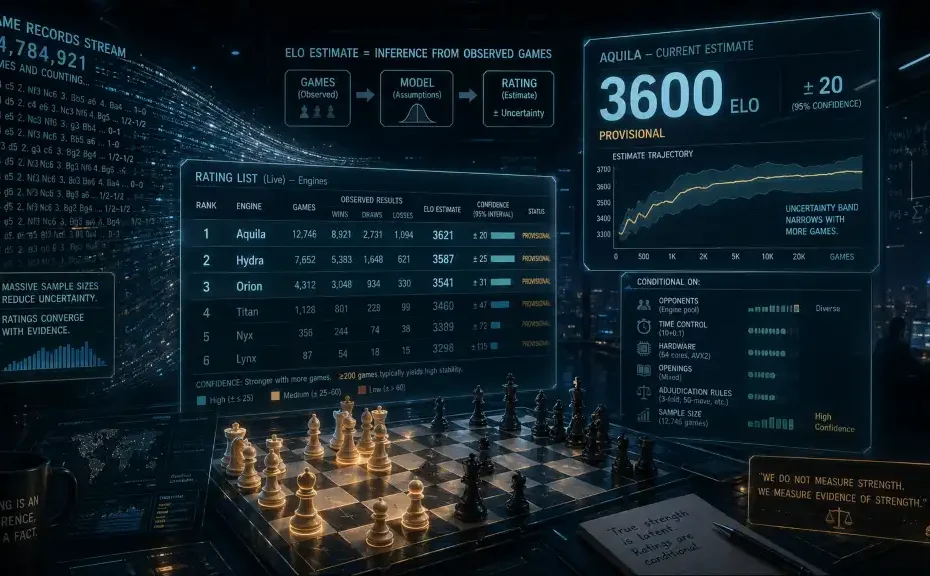
Sample Size in Chess Engine Rating Lists
Chess engine rating lists are useful only when readers understand what the numbers can and cannot say. A rating is not a decorative label attached to an engine. It is a statistical estimate derived from game results, tournament conditions, opponent distribution, time control, hardware assumptions, opening policy, and rating methodology. For that reason, sample size is one of the most important concepts in any serious discussion of computer chess ratings.
In simple terms, sample size means the number of games used to estimate an engine’s strength. In a chess engine rating list, this may refer to the total number of games in the pool, the number of games played by a specific engine, the number of games between two particular engines, or the number of games under a given time control. These are related but not identical. A rating pool may contain millions of games, while a newly added engine may still have only a small provisional sample. That difference matters.
For IJCCRL readers, this is especially important because <a href=”/”>chess engines ratings lists</a> are not isolated tables. They connect tournament reporting, event downloads, provisional standings, final match audits, archived results, and engine classification. When a reader looks at <a href=”/rating-lists/”>current ratings lists</a>, the first question should not be only “which engine is ranked higher?” It should also be “how much evidence supports this ranking?”
What sample size means in a chess engine rating list
A chess engine rating list converts game outcomes into numerical estimates. Wins, losses, and draws are combined through a rating model, producing an Elo-style value or a similar rating estimate. However, the estimate is not the same thing as the engine’s true strength. The true strength is unknown. The rating is an inference from observed results.
This distinction is central. A 3,600 Elo engine is not metaphysically “3,600 strength” in all contexts. It has performed at a level that the rating system estimates around that value under the testing conditions used. Change the conditions and the estimate may change. Change the opponents, time control, hardware, openings, adjudication rules, or number of games, and the rating surface may move.
Large public computer chess lists illustrate the importance of volume. CCRL’s 40/15 complete list, dated February 28, 2026, reports more than 2.29 million games played by 4,447 programs, and states that its ratings were computed with Bayeselo. It also distinguishes engines tested with 200 games or more from those with fewer games by using bold versus normal font. That visible threshold is a practical editorial reminder: game count affects confidence and presentation.
The important point is not that 200 games is a universal magic number. It is not. The point is that rating-list publishers often need a visible way to signal the difference between better-supported and less-supported entries. A sample of 40 games, 100 games, 200 games, or 1,000 games does not carry the same interpretive weight.
Why tiny samples are dangerous
Tiny samples can be misleading because chess engines do not produce perfectly smooth results. Even very strong engines can lose games because of opening selection, tactical volatility, time-management behaviour, tablebase transitions, contempt settings, search instability, or simply because the opponent found a strong line. A short match may reflect real performance, but it may also exaggerate a temporary run of favourable or unfavourable outcomes.
For example, if Engine A defeats Engine B by 6.5–3.5 in a ten-game match, the result is real. It belongs in the event record. But it should not be treated as a stable proof that Engine A is clearly stronger. Ten games may be enough to report a match result. It is not enough to define a robust long-term rating separation between two engines.
This is one of the most common misunderstandings in computer chess interpretation. A tournament result and a rating-list conclusion are not the same kind of claim. A tournament result answers: “What happened in this event?” A rating-list estimate asks: “What strength level is supported by the accumulated evidence?” Those questions overlap, but they are not identical.
Small samples are especially risky when the Elo gap is small. If two engines are close in strength, a short match can easily produce a result that looks decisive but is not statistically secure. A 55–45 score over 100 games may be meaningful, but it still needs context. A 6–4 score over 10 games is far weaker evidence. A 30.5–29.5 result in a 60-game match may be dramatic and valid as a match result, but it should still be interpreted cautiously as evidence of a large rating gap.
Provisional Elo is not final Elo
The term “provisional” should be used carefully. A provisional rating is not false. It is an early estimate based on limited evidence. It can be useful, especially for tracking new engines, development builds, pre-release versions, or newly compiled binaries. But a provisional number should not be read with the same confidence as a mature rating based on hundreds or thousands of games.
Bayeselo’s own documentation shows why uncertainty matters. It reads PGN game records and produces rating lists, but it also includes concepts such as confidence intervals and likelihood of superiority. The documentation explains that Bayeselo estimates confidence intervals by using the Hessian of the log-likelihood and can produce tables of likelihood that one player is stronger than another.
That means rating software is not merely counting wins and losses. It is modelling uncertainty. The more limited the evidence, the more carefully the result should be interpreted. A rating number without uncertainty information can easily create false precision.
A provisional Elo can still be useful in IJCCRL reporting when it is labelled correctly. It may help readers follow a live league stage, understand the early shape of a rating pool, or compare an engine’s preliminary performance against known opponents. But editorial language should avoid turning provisional values into absolute claims.
Better wording is:
“Engine X is currently estimated at 3,540 Elo in this provisional pool.”
Less careful wording is:
“Engine X is a 3,540 Elo engine.”
The difference looks small, but it is methodologically important.
The role of opponent distribution
Sample size is not just about quantity. It is also about the structure of the sample. One hundred games against a single opponent do not provide the same information as one hundred games against a balanced range of opponents. Similarly, one hundred games against much weaker engines may not reveal the same weaknesses as one hundred games against close rivals.
Bayeselo’s documentation explicitly notes that uncertainty can be affected by the opponent distribution. It gives the example that 10 wins and 10 losses against one 1500-Elo opponent should not create the same uncertainty as 10 wins against a 500-Elo opponent and 10 losses against a 2500-Elo opponent.
This is directly relevant to engine rating lists. If an engine’s sample is concentrated against a narrow band of opponents, the rating may be less informative than the raw game count suggests. A list may show 200 games, but readers still need to know whether those games were structurally useful. Were the opponents close in strength? Were colours balanced? Were openings mirrored? Were the same openings repeated too often? Were the games played under the same time control?
At IJCCRL, this is why event context matters. A rating number should be connected to the rules of the event, the time control, the opening policy, and the PGN evidence. Readers who want to inspect the underlying material should be able to access <a href=”/downloads/”>downloadable PGN packs</a> wherever final or audited provisional packs are available.
Why large samples reduce noise
A larger sample does not make a rating perfect, but it usually reduces random noise. When an engine plays many games, isolated tactical accidents, opening traps, or single-match anomalies become less dominant. The rating estimate has more evidence from which to infer performance.
This is why mature rating lists often become more reliable over time. As game volume increases, the rating pool has more information about each engine’s relationship to the rest of the field. Ordo’s documentation describes it as a program for calculating ratings of chess engines or players, noting that it keeps consistency among ratings by calculating them while considering all results at once.
That “all results at once” principle matters. A rating pool is a network. Engine A’s rating is not only based on its direct results against Engine B. It is also influenced by how A and B performed against the rest of the connected pool. This network effect can improve stability, but it also means that pool composition, connectivity, and data volume matter.
A large but poorly connected pool can still create interpretive problems. A smaller but well-controlled event can be useful for a specific purpose. The methodological question is not simply “how many games?” It is “how many relevant, well-structured, correctly recorded games under known conditions?”
Confidence and Elo gaps
Rating differences should be interpreted together with uncertainty. A gap of 5 Elo or 10 Elo is usually not enough, by itself, to support a strong claim unless the sample is very large and the uncertainty is correspondingly small. Even then, readers should avoid overstating the meaning of small differences.
In practical reporting, it is safer to treat small Elo gaps as ranking indicators, not definitive proof of superiority. A list may need to rank engines in numerical order, but the editorial interpretation should be more cautious. Two engines separated by a few Elo points may be effectively equivalent within the limits of the available data.
This is especially important for modern top engines. Draw rates can be high, differences can be narrow, and engine builds can change quickly. A development build may gain or lose apparent strength depending on the opening book, hardware, time control, and the specific opponent mix. Therefore, a tiny Elo gap should not be inflated into a broad claim about architecture, search quality, or engine superiority.
Better wording is:
“Engine A is currently listed slightly above Engine B in this rating pool.”
Less careful wording is:
“Engine A is stronger than Engine B.”
The first statement describes the table. The second may exceed the evidence.
Match results versus rating-list evidence
A single match can be valuable without being sufficient for a stable rating conclusion. Knockout matches, finals, semifinals, and qualification events are essential parts of competitive reporting. They decide who advances, who wins, and how an event is archived. But rating lists ask a broader question.
A match result is bounded by its format. If two engines play 60 games at Classical 40+2 using a defined opening set, the result is valid for that match. If the same engines later play 600 games across a broader opening distribution, the rating estimate may move. That does not invalidate the match. It simply means that match evidence and rating evidence operate at different levels.
For IJCCRL, the correct editorial approach is to preserve both truths. Event reports should state the result clearly. Rating commentary should state the level of confidence cautiously. If a result is provisional, audited, adjusted, or derived from a limited sample, that status should remain visible.
This is not a weakness. It is a strength. Serious rating lists are credible because they do not pretend that every number has the same evidentiary value.
Practical reading rules for IJCCRL users
Readers can apply several practical rules when interpreting any chess engine rating list.
First, check the number of games. A rating based on 30 or 60 games is much more fragile than one based on several hundred games. It may still be useful, but it should be labelled and interpreted as provisional.
Second, check the time control. A fast time-control rating is not automatically transferable to a classical rating. Engines may scale differently with time, hardware, and search depth.
Third, check whether the PGN is available. A transparent rating ecosystem should allow readers to inspect game records, event structure, and results where possible. Downloadable PGN packs are not cosmetic. They are audit material.
Fourth, check whether the event used balanced colours and controlled openings. Mirrored openings and colour balance can reduce certain types of bias, especially in engine-versus-engine testing.
Fifth, avoid overinterpreting tiny Elo gaps. A table must rank engines, but readers should treat very small differences as approximate unless the sample and uncertainty justify stronger language.
Finally, separate event victory from rating dominance. An engine can win a match without proving a large long-term rating advantage. Conversely, an engine can be highly rated and still lose a short match under specific conditions.
Methodological limits
No rating system removes uncertainty completely. Bayeselo, Ordo, and similar tools provide structured ways to estimate strength from game results, but they depend on the quality and structure of the input data. If the PGN contains errors, duplicated games, unbalanced colours, inconsistent time controls, or misleading engine names, the rating output can be affected.
Bayeselo’s documentation states that its Bayesian approach requires assumptions beyond the usual Elo formula, including probabilities for win, draw, and loss as functions of Elo difference. Ordo similarly calculates ratings from PGN input and can output text or CSV rankings, but the reliability of the output still depends on the quality of the games supplied.
Therefore, rating methodology should not be treated as a black box. The software matters, but so do the event rules, data hygiene, naming consistency, time control, opening policy, adjudication rules, and audit trail.
A scientifically careful rating list does not claim more than its data can support. It distinguishes between final and provisional material. It explains whether a number comes from a complete pool, an event-specific subset, or a temporary league table. It avoids declaring tiny differences as decisive unless the evidence is strong enough.
Conclusion
Sample size is one of the central safeguards in a chess engine rating list. More games usually mean more evidence, but game volume alone is not enough. The games must also be relevant, correctly recorded, structurally balanced, and interpreted with the correct level of caution.
For IJCCRL, the best editorial practice is to present ratings as estimates, not absolute truths. Provisional Elo should be useful but clearly labelled. Small samples should be reported, but not exaggerated. Large samples should inspire more confidence, but not eliminate methodological caution.
A reliable chess engine rating list is not the one that pretends uncertainty does not exist. It is the one that shows readers how much evidence supports each conclusion and allows them to interpret every rating with the appropriate level of care.

Jorge Ruiz Centelles
Filólogo y amante de la antropología social africana